events-banner

Background

Overview of FOA

Membership of FOA

Membership to FOA is open to persons (including corporate and also body of persons whether corporate or unincorporate), being forest owners, as from time to time are accepted for membership of the Association.

Forest Owner shall be deemed to mean any person who is the owner of a forest area as defined as an area of land on which trees have been established including associated roads reserves and firebreaks.

Any forest owner may apply for membership  which is considered by the FOA Executive Council  (usually at the next meeting). An annual subscription is paid based on a declaration of your forest estate area and is currently set at 20c per hectare or $200 per year if the forest area would generate less than that figure.

Members are expected to adhere to the Agreement and Accords we have signed on behalf of all members and adhere to the FOA Code of Ethics and Diversity, Equality and Inclusion Policy.

For further information please contact FOA.

Application Form

Required evidence from the Companies Office:

  • Company number
  • New Zealand Business Number
  • Incorporation date
  • Company status
  • Entity type (eg New Zealand limited company)
  • Registered Office and address for service
  • Names of company directors


FOA Offices Wellington and Rotorua

Wellington

Chief Executive:  Elizabeth Heeg
Chief Operating Office: Joseph Brolly
Office Manager:  Rosemary McFadyen
Accountant:  Jeff Drinkwater
Communications Manager:  Emily Pope
Senior Communications Advisor:  Sarah Walker
Biosecurity Manager:  Brendan Gould
Environment Manager:  Rachel Millar
 

CONTACT DETAILS

Physical address:
Level 9, 93 The Terrace
Wellington

Postal address:
PO Box 10986
Wellington 6140

Tel : +64 4 473 4769
Email: This email address is being protected from spambots. You need JavaScript enabled to view it.

MEDIA CONTACTS

The President, Chief Executive and Communications Manager are normally the only spokespeople for the FOA.

However, on some topics they may delegate someone with special expertise to speak on behalf of the Association.

Chief Executive
Elizabeth Heeg
Tel: 04 473 4769
Mobile: 0273 833 448

Media
Emily Pope - Communications Manager
Tel: 04 473 4769
Mobile: 027 6176 200
Email: This email address is being protected from spambots. You need JavaScript enabled to view it.      

President
Matt Wakelin
Mobile: 027 588 4448

Rotorua


R & D Manager: Paul Adams
Innovation Manager: Alison Slade
Office Manager: Amanda Brake
99 Sala Street   PO Box 1127  Rotorua 3040
Telephone (07) 921 7246

Research website


FOA Past Presidents and Chief Executives


Year/s
Name
Past Presidents  
2022 - 2024 G Dodson
2020 - 2022 P Taylor
2018 - 2020 P Weir
2016 - 2018 P Clark
2013 - 2016
P Nicholls
2011 - 2013
B McCallum
1999 - 2011
P Berg
1998
N Roberts
1995 - 1997
E D Robinson
1993 - 1994
P J Hill
1992
M J McAlonan
1989 - 1991
B C Heard
1987 - 1988
A W Grayburn
1981 - 1986
B W Wall
1977 - 1980
P I Baker
1972 - 1976
J E Henry
1967 - 1971
J T Currie
   
 Chief Executives  
2023 - current Elizabeth Heeg
2005 - 2023 David Rhodes
1997 - 2005 Rob McLagan
1991 - 1997 Ken Shirley

FOA History

The Association has been a representative of, and forum for, commercial plantation forest growers since early in the 20th century.  Then known as the Dominion Forest Owners’ Association, it was particularly active  between the wars, but languished for a period post the Second World War.

The Dothistroma scare and incursion in the mid 1960s was the trigger for renewed interest in a national organisation for forest growers and for the imperative of collective action.

New life was breathed into the Association with a new set of rules registered in September 1968 and a new Executive Council comprising leaders in the industry.  At that time the New Zealand Forest Service, which held more than half of New Zealand’s planted forest estate, was not a member but the Association worked very closely with the NZFS in the interests of the industry, even having an NZFS representative (CGW Mason) as a member of the Executive Council.  Jim Currie of NZ Forest Products was President and led the rejuvenation of the Association.

HB Martin (with AG Hall as assistant) who had been involved with other forest-based associations, e.g. the National Institute of Wood Preservers, since the 1950’s, were appointed as the Wellington office about 1967/68.

The corporatisation of NZ Forest Service in the 1980s/90s opened the way for the former state forests to come into membership. 

The principal object of the Association, as per the new (1968) rules was set out as:  “To promote and protect the interests of persons from time to time engaged or concerned in New Zealand in the business, trade or industry of forestry”.  There followed a long and detailed list of specific activities which could be summarised as promoting the industry both in respect of the public interest and in respect of its products, lobbying within both central and local government, collective action and mutual collaboration on things like fire control and other hazards, research and to generally guard, promote and protect the rights and interests of members.

 Whilst the emphasis has changed from time to time in the light of opportunities, developments and threats, current activity remains to the same intent.  


Strategies

FOA Strategies

Forestry Roadmap to 2050) (PDF download 2MB) March 2019

Forest Growers Science and Innovation Strategy to 2050 (PDF download 5.84MB) November 2019

-----

Position Papers

Position paper - Genetically Modified Organisms July 2019

-----

Woodco Strategies

2011 Forest Industry Study (June 2011)

Building a Stronger Future for Wood - This is a report prepared for the Woodco Board by Dave Hilliard, Tom Clark, Stuart Anderson and Paul Lane.

 Forest and Wood Products Industry Strategic Plan 2006 - 2021 (created 2009 and modified)

This plan was prepared for Woodco by FOA, NZFFA, WPA, PMA, FICA

Woodco Research Science & Technology Group Statement on Research & Development for the Forest Industry (July 2010)

Prepared to provide pan-industry strategic direction on RS & T; to outline the key elements that the forest industry expects to see in any Statements of Core Purpose (SCP) and Statements of Core Intent for CRI’s delivering research to the forest sector and to be used as the basis of input to Government, including MoRST and FRST, to influence the development of SCP’s and SCI’s for relevant CRIs.

-----

Superceded Research Strategies

Forest Biosecurity Research Strategy (January 2011) SUPERCEDED by November 2019 document

The Forest Biosecurity Research Strategy is for FOA members in the first instance and provides guidance on key biosecurity issues. The strategy also provides a unified voice for the industry to communicate research priorities to funding agencies and research providers in order to have greater influence on R&D investment and capability retention and development in New Zealand.

 New Zealand Forestry Science and Innovation Plan (November 2015) SUPERCEDED by November 2019 document

This Innovation Plan concerns the forest growing sector and its focus on excelling in the management of plantation forests to deliver logs and other woody biomass to the downstream processing sectors of the forest industry

-----

About the forest growing sector

The plantation forestry and logging sector directly accounts for 0.6% of GDP or $1,389 billion. This contribution is:

  • Greater than the GDP contribution of the sheepmeat and wool sector by over 20%
  • About 45% larger than beef sector in GDP terms
  • At a similar level of contribution with horticulture
  • 0.9% of the total goods producing industries
  • Approximately 2.9% of merchandised exports.

 The plantation forestry industry’s influence extends well beyond its direct impacts. Forestry and logging are closely intertwined with the rest of the economy and society. This includes jobs, and the incomes it provides, its links to other industries (e.g. transport), the impact it has on rural and urban centres and the environment

$3.8 billion in plantation forestry production value was produced by growing and logging trees nationally in 2015:

  • $301 million went on wages and salaries
  • $1,100 million went on capital and land
  • $2,400 million was spent on inputs (mainly contractor services)
  • $171 million was spent on freight to get products to market (not included but dependent on forestry)

Investment by the industry via the Forest Groweres Commodity Levy, ers in research and technology, supported by the NZ government, means plantation forestry is highly innovative. This is reflected in the commitment of the association and its members to the highest standards of sustainable silviculture, environmental practice and workforce safety.

In recent years this has led to be development of codes of practice and standards which have world-leader status. These codes and standards have been adopted by most industry players.

The FOA and NZ Farm Forestry Association (FFA) are the prime industry representatives in the plantation forest growing sector.

The FOA represents the owners of New Zealand's commercial plantation forests. It was set up in 1926 and is now one of the country's most influential primary sector organisations. Its members own or manage around two-thirds of the country's 1.79 million hectares of plantation forests and are responsible for over 70% of the annual harvest.

The NZFFA was formed in 1957. Membership is spread over 27 Branches throughout NZ, and there are 6 special interest groups. NZFFA estimate their members own or manage up to 100,000Ha of forest, and influence the management of a similar area. These forests consist of radiata pine, cypress, eucalypts, redwood, blackwood, other exotic species and managed indigenous forests.

The Forest Grower Levy Trust (FGLT ) is the body responsible for collecting the harvested wood products levy from forest growers. Forest Growers via the FOA and the FFA manage the allocation of levy funds to industry good projects. Final decision and oversight of levy spend is with the FGLT.

Joint committees between FOA and FFA provide opportunities for industry representation and input.

The Forest Industry Safety Council (FISC) is an independent body, substantially funded by the Forest Grower Levy Trust (FGLT).

Close liaison and contact is maintained between other industry bodies such as FICA and Competenz , with representatives attending industry meetings as required.

The Wood Council of NZ (Woodco) brings together the forest growing and forest product processing sectors.
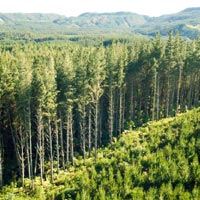
 

Emissions Trading Scheme

Emissions Trading Scheme

FOA has made sure the forest industry view
has been heard on the Emissions Trading
Scheme and the potential contribution forestry could be making to NZ’s environmental goals.

Environmental Code of Practice

FOA Environmental Code of Practice

Over a period of three years the Forest Owners Association with input from its members
developed the "FOA Environmental Code of Practice".

Drug & Alcohol Code of Practice

FOA Drug and Alcohol Policy

The FOA Drug and Alcohol policy was launched
in October 2008, then taken to a series of
regional launches attended by nearly 1500 industry professionals.