Plantation forestry

Employment

Measuring who is employed in forestry is not a trivial exercise. Due to the seasonal nature of silviculture and planting, some official statistics can under-estimate forestry employment depending on when employees are surveyed. Statistics New Zealand also classifies industries by main economic activity, this means any part-time forestry operators will not be included in official statistics. The Census showed that on 5 March 2013 there were 7,056 employed in the forestry sector. The Census is self-reported; it relies on people correctly filling in their occupation and employer and for Statistics New Zealand to correctly classify that occupation.  To demonstrate the impact of classifying industry by main activity and self-reported occupation. In the latest Census, 35 percent of forestry related occupations 37 were employed in non-forestry industries (largest being Management Advice and Related Consulting Services).

37 Forestry Worker, Production Manager (Forestry), Logging Assistant, and Forest Scientist.

38 Turnover greater than $30,000 per year.

39 https://www.competenz.org.nz/

Further, the Census will under report forestry employment since it collects data in March, while the peak typically in occurs in September/December quarters.  A more reliable approach is to use the Linked Employer Employee Data (LEED). The LEED database uses employer monthly tax returns. Being administrative data of all economical significant businesses 38 that file a tax return it has great coverage and unlike the Census collects monthly tax returns. However, like the Census it has problems with industry data being classified by main activity.  The LEED database shows 7,287 people employed in the forestry sector, with an additional 2,223 people self-employed in the sector. A total of 9,510 people working in forestry.  For health and safety reasons the major industry players also collect the number of hours worked through the Incident Recording Information System (IRIS) database. It records the number of hours worked by employees in larger forest owner/management companies. Unfortunately, not all companies contribute consistently to the IRIS database.  The number of hours can be converted using average hours from the quarterly employment survey. This suggests 7,142 FTEs. Since we know that not all companies contribute or contribute only infrequently to the database, this number therefore is conservative.  Informetrics also report on the Competenz39 website that forestry has 10,846 filled jobs. A filled job is not equivalent to FTE since it could be part time. Therefore, the Informetrics estimates are not comparable.

NZIER report – Plantation forestry statistics 33

Table 7 Triangulation of employment data

2015 Source

Totals

Census

7,0561

LEED database

9,5101

IRIS database

7,1421

Informetrics

10,8462

Note (1) full time equivalents. (2) Filled jobs.


NZ's third largest export industry

Forestry export revenue is forecast to rise to $6.9 billion in the year ending June 2019, an increase of 7.8% from 2018.


 Export Graph

About 104,000 hectares of Douglas-fir (NZ Oregon) is grown in New Zealand — mostly in the South lsland. Timber from the species has been widely used in New Zealand, the United States and elsewhere for house weatherboards and framing.

It is highly durable so long as proper weatherproofing systems are used during building design and construction. Indeed, the fact that it can be used untreated for these purposes has made it a sought-after alternative framing timber.

For specifications on the use of Douglas-fir in house construction, download The "Alternative Solution" Douglas-fir - May 2004 which is located in our File Library & Resources Section

Since 1990,a quarter of a million hectares of planted forest have been established or re-established in New Zealand — most of it radiata, which makes up 1,572,000 hectares or 90 per cent of total plantings. One-third of the world's radiata forests are grown in New Zealand. Other major producers are Australia and Chile.

Many of these forests were planted for soil and water conservation reasons on erosion-prone hill country which was formerly in sheep and cattle pasture.

Once young radiata become established, they rapidly stabilise steep hillsides, protecting the soil and regulating the rate at which water is able to run off the land. The vegetative litter on the forest floor acts as a sponge — holding and slowly releasing water for many days after the last rainfall. This helps prevent destructive flooding.

Third party certification of sustainable management practices plays an increasingly important role in NZ plantation forest management. Half of the country's plantations and one-third of the annual harvest are already third party certified, with the most popular being the Forest Stewardship Council (FSC) system.

On average, radiata pines grown in New Zealand are harvested at 29 years. The timber has excellent nailing, gluing and painting properties and is also used as a feedstock for the manufacture of paper and industrial packaging materials.

The New Zealand forest industry is based on sustainable plantations of predominantly Pinus radiata, commonly known as radiata pine, Monterey pine or New Zealand pine. Douglas-fir and various cypress and eucalypt species are also grown for timber.

FOA members manage around two-thirds of plantation forestry of New Zealand’s 1.79 m ha plantation forestry estate.

Forestry in New Zealand is geared to both domestic and export demand. Some  44% of harvested logs and varying percentages of processed forest products are destined for world markets. Seven countries – Australia, China, Japan, the Republic of Korea, the US, Indonesia and India – account for more than 80 per cent of the value of these exports. Apart from logs, exports include sawn timber, wood chips, panels, pulp and paper and other products. 

China is the major driver of recent demand, as a result of strong economic growth, continued urbanisation, and the effect of the Russian log export tax. India and Japan also have the potential to grow because of strong economic growth in India and post-earthquake re-building in Japan.

Forestry expects to be New Zealand's leading export industry and a top five global supplier by 2025. These goals are ambitious but attainable, due to a combination of the burgeoning global population, expanding demand for sustainably produced wood products, and vast areas of new forest reaching a harvestable age at the right time.

foaweb 2014

foaweb 2014 area

Log exports were static at $1.6 billion for both 2011 and 2012. Log exports totalled 13.8 m m3 compared to 3.7m m3 being processed in New Zealand

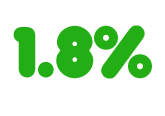
The net stocked forest area increased by 100 hectares from 2011 to 2012 to 1,719,500 hectares. Acccompanied by an increase in the average standing volume from 279 m3 means the estimated standing volume of wood in New Zealand's plantation forest is 488 million m3, an increase from 2011 of 1.8%

Source: MPI 2013  year ended 31 December / MPI Statistical Releases 

Detailed statistics on the NZ plantation forest industry are in the forestry Facts & Figures publication.

Carbon sequestration is the process by which carbon dioxide is absorbed during photosynthesis, and is stored as carbon in biomass (trunks, branches, foliage, and roots). Gains in forest carbon stocks through growth and sequestration will reach a maximum level over time, and are eventually offset by carbon losses through harvesting, thinning, and natural decay.

To determine the total carbon sequestered in a forest at any given time (the forest carbon stocks) it is necessary to work out how much carbon is in:

  1. The above-ground live biomass, which includes the stem, branches, and leaves or needles.
  2.  The below-ground live biomass, which is the root system of the tree. Once the tree is harvested this usually decays slowly.
  3.  The coarse woody debris, which includes all larger woody material left on the forest floor after any pruning, thinning or harvesting operations. This coarse woody debris decays over time.
  4.  The fine litter, which is composed of decaying leaves or needles, and small branches and twigs. This usually increases slowly over time, until a balance between average annual litter inputs and decay is reached.

The forest estate is already a significant store of carbon and there is potential for this to grow further with farm and larger-scale plantings of both exotic and indigenous forest species.

World concern about global warning as a result of human activity has led to New Zealand signing the Kyoto Protocol. This commits New Zealand to reducing its net greenhouse emissions to 1990 levels by 2012. New Zealand has chosen to introduce an emissions trading scheme to manage its Kyoto commitments. The ETS essentially puts a price on the emission of greenhouse gases.

Because New Zealand's rapidly growing plantation forests are estimated to sequester (absorb) 25 million tonnes of CO 2 from the atmosphere each year, they have an important role to play in the country meeting its Kyoto commitments and forestry was the first sector to enter the Emissions Trading Scheme in January 2008.

Forest biomass consists of about 50 percent carbon and over time most of the change in forest carbon stocks comes from changes in the biomass of the four biomass ‘pools’ listed above. Changes in the amount of carbon stored in forest soils also occur over time, but these are small and difficult to measure at reasonable cost. Changes in forest soil carbon will not be required to be measured under the ETS.

The climate change policy for forestry is still evolving. Initially the government announced that it would retain all credits and liabilities associated with growing forests. Under pressure from forest growers the government reversed this decision and owners of post-1989 forests now have the option of assuming both carbon credits and liabilities. Issues still remain around the treatment of owners of pre-1990 forestry who face a significant liability for any deforestation that occurs. Deforestation is forest clearance, followed by a change to another land use (for example, to grazing). After deforestation, the deforested area is classified as non-forest land.

Post-1989 forest land is exotic or indigenous forest that is established after 31 December 1989 on land that was not forest land on 31 December 1989 (that is, was non-forest land on 31 December 1989)

Pre-1990 forest land is an area of forest land covered by predominantly exotic forest species that was established on or before 31 December 1989 and that remained forest land on 31 December 2007.

Forest land is defined as being at least 1 hectare (ha) with forest species that have (or are likely to have at maturity):

  • a crown cover of more than 30% on each hectare
  • a crown cover with an average width of at least 30 metres.

Forest species are trees capable of reaching five metres in height at maturity in the place they are growing.

All participants in the ETS will have three core obligations:

  1. Monitor the emissions they are responsible for
  2.  Report these each year to the Government
  3.  Surrender emissions units to cover their reported emissions.

The Government will issue a number of emissions units for forest carbon sinks (that meet the required criteria) and these may be held, or bought and sold (that is, traded), within New Zealand. The primary unit of trade in the ETS will be the New Zealand Unit (NZU). One NZU represents one tonne of carbon dioxide (CO2) either released to the atmosphere (emissions) or removed from the atmosphere (removals).

Some of the rules under the Land Use, land Use Change and Forestry (LULUCF) section of the Kyoto protocol that New Zealand has signed up to are illogical and have had a negative and disruptive impact on forest investment in New Zealand because the government has chosen to directly apply these same distortions through domestic policy.

The LULUCF sector deals with the changes in carbon stocks and emissions of greenhouse gases associated with the land based activities, including management of pre-1990 forests (Article 3.4) and Afforestation/Reforestation (new forests planted post-1990 under Article 3.3) – including Afforestation and Reforestation under the CDM; and Deforestation;

FOA is working hard to ensure that problems with the LULUCF rules are addressed both domestically and internationally. Improved rules can optimise the contribution forests and land use activities can make to addressing climate change, while maintaining environmental integrity and leading to other environmental co-benefits that will contribute to sustainable development.

When European settlement began in earnest in the mid-1800s, much of New Zealand was covered in native forests and shrublands.

Many of these forests were cleared to create sheep, cattle and dairy farms. Timber from the forests was used to build the country's rapidly growing towns, as well as fences on farms.

Despite laws to encourage tree planting, the clearance of native forests was so rapid that by 1913, some native species were threatened with extinction. In 1918 exports of native timber were restricted, and in 1925 the Government introduced financial incentives to create plantations of imported species and to reduce the pressure on native forests.

Radiata seed had been imported from California in the 1840s to grow shelter for farms. Because the species had been shown to grow faster here than anywhere else in the world, it became the tree of choice for forest plantings.

Mass plantings in the 1920s and 1930s, and again in the 1960s, created a robust exotic plantation forestry industry that was soon able to supply all New Zealand's domestic timber needs and secure the future of the remaining native forest.

In 1986 –87 the Government's forest assets were split between the Department of Conservation (to manage protected native forests) and the New Zealand Forestry Corporation (to manage plantation forestry operations). This ring-fenced most of New Zealand's native forests for conservation and restricted the commercial harvesting of native timber. Since then most of the corporation's forests have been sold to commercial interests.

In 1991, representatives of four forest industry organisations and 10 conservation groups signed the New Zealand Forest Accord, a joint commitment by forest companies and conservationists to value, protect and conserve New Zealand's indigenous forests. It recognises the importance of commercial plantation forestry both as an economic activity and as an alternative to the depletion of natural forests.

Today, forests cover 31 per cent of New Zealand's land surface — 24 per cent is indigenous (native) forest and 7 per cent plantations of mainly exotic species.

Industry Videos

video

Related Links

Careers in Forestry - training and career information

Commodity Levy - information relating to the levy

Planted Forests Portal - key statistics

IRIS - Incident Reporting Information System

Rare species - managing rare species in plantation forests

Log Transport Safety Council - to report incidents of log truck driver behaviour (good and bad)

FISC - The safety body for the forestry sector.

Management of Fire in Our Forest and Rural Landscape Conference 2025